


Views: 0 Author: Site Editor Publish Time: 2026-03-17 Origin: Site


Metal Sheet Bending Parts play an essential role in the manufacturing industry, forming the basis of many products ranging from automotive components to electrical enclosures. The process of bending metal sheets involves various techniques and equipment, designed to shape and form materials with precision. This article provides a detailed look into how Metal Sheet Bending Parts are processed, including methods, equipment setup, challenges, and solutions.
The process of Metal Sheet Bending is a multi-step operation that involves several key stages to ensure that the material is accurately bent to the desired shape. Below is an outline of the main steps involved:
The first step in the metal sheet bending process is preparing the material. This involves:
Cleaning: The sheet metal must be free from oils, dirt, and other contaminants that could affect the bending process.
Measuring: Precise measurements of the sheet metal are taken to ensure that it will fit correctly in the press brake and that the bends are made at the right locations.
The bending method chosen depends on the material's thickness, type, and the desired angle. Some of the common methods used are:
Air Bending: This is the most common method used for bending thinner materials and provides more flexibility in terms of bending angles.
V-Bending: This method is used when more control is needed, particularly for thicker materials. It provides a more precise bend but requires higher forces.
Bottoming: This method is used for more precise bends where the exact angle is crucial. It ensures a tighter bend, often used for intricate designs.
Once the material is prepared and the bending method chosen, the next step is setting up the equipment. The press brake and tooling must be properly configured to handle the specific material type and thickness. The following key points are considered in this phase:
Tooling Setup: Proper tooling, such as punches and dies, are selected to ensure that the material will be bent accurately.
Press Brake Calibration: The press brake's settings, including tonnage, bend angles, and stroke length, are calibrated to meet the specifications of the material being bent.
Different types of bending methods are used to achieve various results, depending on the material being processed. Below, we will dive into the most common bending methods used in Metal Sheet Bending Parts production.
Air bending is one of the most commonly used bending methods. It involves placing the sheet metal between a punch and die and then applying force to the punch, which bends the metal to the desired angle. The material is only deformed at the point of contact, and the metal "springs back" to its original position once the force is removed.
Advantages: Faster, lower tool wear, and adaptable for different thicknesses.
Disadvantages: Less precision than other methods; requires careful control of springback.
In V-bending, the metal sheet is placed in a V-shaped die, and a punch is applied to the sheet to create the bend. This method is typically used for thicker materials and offers better control over the bending process.
Advantages: More control over the bend, especially for thicker materials.
Disadvantages: Slower than air bending and requires higher tonnage.
Bottoming is a more precise bending method where the metal is forced into the die cavity. This method is typically used when high precision is required for the final product.
Advantages: Produces tight, precise bends.
Disadvantages: Requires more force and is typically slower than air bending.
Bending Method | Advantages | Disadvantages | Best Used For |
Air Bending | Fast, flexible, suitable for different thicknesses | Less precision, springback issues | Thin materials, quick production |
V-Bending | High control, precise bends | Requires higher tonnage, slower process | Thicker materials |
Bottoming | Highly precise, accurate bends | Slower, higher tonnage required | Intricate parts, tight tolerances |
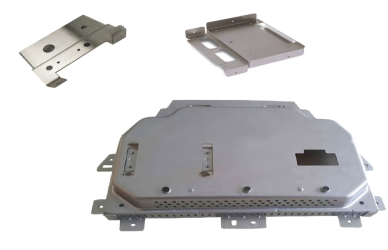
The press brake is one of the most important machines used in Metal Sheet Bending Parts production. It is used to apply force to the sheet metal in order to achieve the desired bend. Proper press brake setup and operation are essential for ensuring high-quality and accurate bends.
Press brakes are machines used to bend sheet metal. They come in different configurations, including mechanical, hydraulic, and CNC press brakes. CNC press brakes are the most precise, as they allow for automatic control of the bending process, including force, angle, and stroke length.
CNC Press Brakes: These machines are fully automated and offer the highest precision and repeatability, making them ideal for complex and high-volume production.
Hydraulic Press Brakes: These machines use hydraulic force to bend the material and are typically used for medium to large-scale production.
Mechanical Press Brakes: These are the most basic type of press brakes, offering a limited range of precision but are still useful for simpler tasks.
Selecting the right tooling is crucial for achieving accurate bends. Dies and punches are used to form the material, and the choice of die shape and punch material can significantly affect the quality of the bend.
Die Setup: The die shape must match the required bend radius, and the die material must be durable enough to withstand the bending forces.
Punch Setup: The punch is the component that applies force to the material. It must be aligned with the die to ensure uniform bending.
Tonnage refers to the amount of force required to bend the metal sheet. It is calculated based on the material's thickness, type, and bend radius. Incorrect tonnage can lead to incomplete bends or excessive stress on the material.
While Metal Sheet Bending Parts are relatively straightforward to produce, several challenges can arise during the bending process. These challenges can affect the final product's quality, durability, and appearance.
Springback is a phenomenon where the metal returns to its original shape after being bent. This can result in the bend angle being slightly different from the intended angle.
Solution: To compensate for springback, manufacturers often "over-bend" the material or adjust the machine settings to account for the material's elasticity.
Surface defects, such as scratches, dents, or blemishes, can occur during the bending process, especially if the tooling or material is not handled properly.
Solution: To avoid surface defects, clean tooling and materials, use protective covers, and select materials with better surface finishes.
Achieving precise and consistent bends is crucial for Metal Sheet Bending Parts. Any variations in bend angle, radius, or length can lead to defects and functional issues.
Solution: Use high-precision press brakes, properly calibrated tooling, and effective bend sequence planning to ensure accurate results.
Air bending and V-bending are two common techniques used in metal sheet bending, each with its unique advantages. Air bending is faster and more versatile, allowing for bends at various angles with minimal setup time. However, it offers less precision, especially for thicker materials or when tight tolerances are needed. V-bending, on the other hand, offers better control and accuracy, making it ideal for thicker materials. While it requires more force and is slower than air bending, V-bending is the preferred method when high precision is essential, especially for parts with strict tolerances.
Tonnage is the amount of force needed to bend a metal sheet and is calculated based on material thickness, bend radius, and the size of the part being bent. Thicker materials require more force, as they are harder to deform, and smaller bend radii require more force to prevent material damage. The general formula for tonnage involves multiplying the material's width by its thickness squared and the bending force, and then dividing by a constant. Correctly calculating tonnage ensures that enough force is applied to bend the material properly, preventing incomplete or excessive bending.
Springback occurs when metal returns partially to its original shape after bending, due to its elastic properties. This is particularly noticeable in high-strength materials, which are more prone to springback. Factors like material type, bend radius, and thickness all influence the degree of springback. Thicker materials tend to have less springback, while smaller bend radii often result in more springback. To compensate for this, manufacturers often "over-bend" the material or adjust press brake settings, ensuring the final bend angle is correct after springback.
Surface defects such as scratches, dents, and blemishes are common during the bending process, especially if tooling or material handling is not done carefully. To prevent these defects, it is important to maintain clean and well-maintained tooling, as dirt and wear on the punches and dies can cause surface imperfections. Proper handling of the metal sheets is also crucial; using protective covers and gloves can help avoid scratches or damage. Additionally, selecting materials with better surface finishes and using lubricants can reduce friction and prevent defects, ensuring that the final product has a smooth, defect-free surface.
Metal Sheet Bending Parts are an essential component of modern manufacturing, with various methods and equipment used to process the metal sheets accurately. The bending process requires careful consideration of material type, method selection, press brake setup, and tooling design. Understanding and addressing challenges such as springback, surface defects, and dimensional accuracy are crucial for achieving high-quality results.
As technology advances, automation and smart manufacturing are expected to play an increasingly important role in improving the precision and efficiency of Metal Sheet Bending Parts production, further driving innovation in industries like automotive, aerospace, and electronics.


