


Views: 0 Author: Site Editor Publish Time: 2026-03-23 Origin: Site


Metal Sheet Bending Parts are essential components in many industries, from automotive to aerospace, and the process of bending metal sheets plays a crucial role in shaping these parts. Different bending methods are used to achieve specific designs, and the choice of method depends on various factors, including material type, thickness, precision requirements, and production volume. In this article, we will explore the most common bending methods for Metal Sheet Bending Parts, highlighting their advantages, applications, and when each method is most suitable.
Metal Sheet Bending Parts can be created using a variety of bending methods. The choice of method largely depends on the material's characteristics, the part's desired shape, and the precision required. Each bending method has its own set of advantages and challenges, making it important to understand their differences before deciding which to use for a given application.
The main bending methods used in metal sheet processing are:
Air Bending
V-Bending
Bottoming
Roll Bending
Coining
In the following sections, we will explore each method in detail, discussing its process, applications, advantages, and limitations.
Air bending is one of the most commonly used methods for Metal Sheet Bending Parts. In this process, a metal sheet is placed between a punch and a die. The punch applies force to the sheet, causing it to bend into the desired angle. The metal does not make full contact with the die, leaving a gap between the material and the bottom of the die. This method is known for its versatility and is frequently used for a wide range of materials, especially thinner sheets.
Flexibility: Air bending is versatile and can accommodate different bend angles and thicknesses with ease.
Speed: This method is typically faster compared to other bending methods, making it suitable for high-volume production.
Low Tool Wear: Since the material does not come into full contact with the die, tool wear is generally low.
Less Precision: Air bending provides less accuracy compared to other methods, especially when tight tolerances are required.
Springback Issues: The process may result in material springback, requiring compensations during setup.
Applications: Air bending is suitable for lighter materials and applications where high-volume, fast production is essential. It is often used in the automotive and appliance industries for producing simple bent components.
V-Bending is another popular bending method used in Metal Sheet Bending Parts. In this method, the metal sheet is placed in a V-shaped die, and the punch applies force to bend the sheet into the desired shape. The V-shaped die helps to control the bend more accurately than air bending, making it ideal for thicker materials or applications requiring greater precision.
Higher Precision: V-bending provides better control over the bend angle, offering higher accuracy than air bending.
Suitable for Thicker Materials: This method is often used for thicker materials, as the V-shaped die provides better support during bending.
Consistent Results: The V-die ensures that the bend is more uniform, which is essential for parts that need to meet strict tolerances.
Slower Process: V-bending tends to be slower than air bending because it requires more setup time and higher tonnage.
Higher Tooling Cost: The V-die needs to be carefully designed for each specific part, leading to higher tooling costs.
Applications: V-bending is used for parts that require precise bends, particularly for thicker materials or applications where accuracy is critical. It is commonly used in industries such as aerospace, defense, and manufacturing for structural components.
Bottoming is a more precise bending method in which the metal sheet is bent all the way into the die, unlike air bending, where the sheet only comes into partial contact with the die. This method ensures that the part achieves a more exact bend and can be used for highly detailed parts with tight tolerances.
High Precision: Bottoming provides the highest level of precision and ensures the bend is accurate to the required angle.
Perfect for Tight Tolerances: This method is ideal for parts that need to meet very strict tolerances.
Stable and Repeatable: Bottoming ensures a consistent result with every part produced.
Higher Force Requirement: This method requires significantly more force than air bending, which can increase production time.
Slower Process: Since the material is fully compressed into the die, the process is slower compared to air bending or V-bending.
Increased Tool Wear: As the metal sheet is forced into the die, tool wear can be higher.
Applications: Bottoming is often used for complex parts that require precise bends, such as in the production of metal enclosures, housings, or parts with intricate geometries.
Roll Bending is a process used to create curved shapes by passing the metal sheet through a set of rollers. Unlike traditional bending methods, roll bending is typically used for large or continuous metal sheets that need to be bent into a curved shape. The metal sheet is passed through a series of rollers that gradually bend it into a cylindrical or conical shape.
Ideal for Large Bends: Roll bending is perfect for large parts that need to be bent into curved shapes, such as pipes or large enclosures.
Continuous Bending: This method allows for continuous bending of long metal sheets, which is beneficial for certain designs.
Versatile: Roll bending can be used for both thin and thick materials, depending on the rollers used.
Limited Precision: Roll bending does not offer the same level of precision as methods like V-bending or bottoming.
Requires Large Equipment: Roll bending typically requires larger machines and more setup, which can make it less cost-effective for small runs.
Applications: Roll bending is commonly used for producing cylindrical shapes, pipes, and curved structures in industries like construction, aerospace, and automotive.
Coining is a high-precision bending method used for producing very tight bends and exact angles in metal sheets. In this method, the metal is forced into the die with high pressure, causing the metal to flow into the exact shape of the die. Coining is typically used for parts that require precise angles, such as components for electronics or fine machinery.
Extremely High Precision: Coining offers the highest precision among all bending methods, making it perfect for parts with very tight tolerances.
Perfect for Small Parts: This method is often used for small parts with complex geometries or intricate bends.
Slow Process: Coining is slower compared to other methods, as it requires high pressure and precise control.
High Cost: The process is more expensive due to the precision and tooling required.
Applications: Coining is ideal for small, high-precision parts that require exact bends and tight tolerances, such as electronic connectors, watch components, or medical devices.
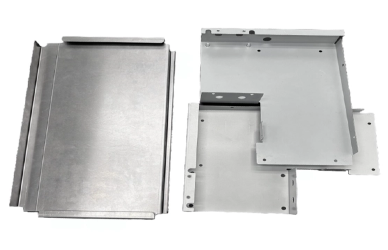
Choosing the right bending method for Metal Sheet Bending Parts depends on several factors, such as material thickness, the required bend angle, precision, and production volume. Below are some key considerations to keep in mind:
Factor | Influence on Bending Method |
Material Thickness | Thicker materials often require V-bending, bottoming, or coining for better control. |
Bend Angle Precision | Methods like bottoming and coining are preferred for tight tolerances. |
Production Volume | Air bending is faster and better for high-volume production. |
Material Type | High-strength materials may need more force and a more controlled bending method like V-bending. |
Cost Efficiency | Air bending is more cost-effective for larger runs, while coining may be expensive for small batches. |
Each method has its place depending on the project’s specific requirements.
Each Metal Sheet Bending method has distinct advantages and challenges, as discussed earlier. Below is a table summarizing the key pros and cons of each bending technique:
Bending Method | Advantages | Disadvantages |
Air Bending | Fast, versatile, low tool wear | Less precision, requires springback compensation |
V-Bending | High precision, suitable for thicker materials | Slower process, higher tooling cost |
Bottoming | Highly precise, perfect for tight tolerances | Slower, requires more force, higher tool wear |
Roll Bending | Ideal for large or continuous bends, versatile | Limited precision, requires large equipment |
Coining | Extremely precise, perfect for small parts | Slow, high tooling cost |
By understanding the strengths and limitations of each method, manufacturers can choose the best technique for their needs.
V-bending and bottoming are generally the best methods for thicker materials, as they provide more control and precision compared to air bending.
The choice of bending method depends on material type, thickness, desired bend angle, production speed, and required precision. Each method has its strengths based on the project’s needs.
Air bending can be used for precision parts but may require compensations for springback, especially with high-strength materials or tight tolerance applications.
Coining offers the highest precision, making it ideal for small parts that require exact bends and tight tolerances, though it is slower and more expensive than other methods.
Metal Sheet Bending Parts are created using various bending methods, each with its specific advantages and ideal applications. Whether it is the fast and versatile air bending method, the precise V-bending, or the high-precision coining method, selecting the appropriate technique is critical for achieving the desired results. As technology continues to evolve, new advancements such as automation and smart manufacturing are expected to further improve the efficiency and accuracy of the bending process.
Understanding the factors influencing bending choices, including material type, thickness, and production requirements, helps manufacturers optimize their processes and ensure high-quality parts.


